Topgolf Stopped Building Venues and Started Licensing Pixels: The Asset-Light GTM Pivot
Go-To-Market Series – Part 2
January 13, 2026
In Part 1 we argued that there is no universal go-to-market playbook, that the most dangerous failures happen during a market's cold "warm-up" period, and that what carries a founder across that cold stretch is not a clever tactic but a clear sense of why they started. This article puts all three claims on trial through a single company, because Topgolf lived every one of them.
It is a story with two founders who were told no by almost everyone, a market that took six years to warm up, a technology that quietly became more valuable than the business it was attached to, and a recent, sobering ending that proves a point most success stories hide: the same product can demand two completely different go-to-market strategies, and choosing the wrong one can cost a company billions.
Let's start where every honest case study should - at the beginning, when nobody believed it would work.
Two Brothers, One Frustration
In 1997, twin brothers Steve and Dave Jolliffe sold their mystery-shopping business and went looking for their next idea. They found it on a driving range, where they were having a thoroughly boring time. Steve's own summary of the problem was blunt: golf is not a lot of fun when you aren't very good at it. The traditional range was sterile and joyless - one executive later described the old model as being like "hitting rocks in a rock quarry."
Their insight was simple and, in hindsight, obvious: what if you could make practice into a game? They embedded a microchip into the golf ball so every shot could be tracked, scored, and turned into a competition. They called it "Target Oriented Practice" - Top for short - and opened the first venue in 2000 in Watford, just outside London.
Notice what the idea actually was. It was not a better driving range. It was a new category - somewhere between a sport, a bar, and a bowling alley. And as Part 1 warned, the more original your idea, the colder the market that greets it. Topgolf was about to spend years in the warm-up.

The Cold Start Nobody Wants To Remember
The early years were rough in exactly the way Part 1 described. The local community didn't provide enough business. The golf establishment actively rejected them. The PGA wanted nothing to do with the concept, and golf-equipment brands declined to partner or supply clubs. Steve described the sport they were trying to crack as obsessed with "the difficulty, the dress code, the silly rules." They were selling fun to an industry that prized seriousness.
Investors were no warmer. When a financier named Richard Grogan was first pitched in 2003, he turned them down flat. He later put the rejection in brutal terms, telling them golf "isn't a business; it's a sport, and it's the second-biggest source of losses of investment capital in the United States besides restaurants." That is the sound of a cold market: not "your product is broken," but "people like me don't buy this."
Here is the Part 1 lesson made literal. The product worked, but the market had to be taught what it was looking at, and that teaching took years and money. A founder reading only the success headlines would never see this stretch. It's the part that kills most companies, and it's invisible in retrospect because the survivors don't dwell on it.
What carried the Jolliffes through? Not data - they had almost none. It was conviction in the need they'd seen: that millions of people who found golf intimidating would happily play if you made it fun. That belief is the why from Part 1, and it's the only thing that keeps a founder in the boat when every investor, every governing body, and every supplier is saying no.
The Detail That Turned A Skeptic Into A Believer
There's a single moment in this story that is worth pausing on, because it captures something your spreadsheets never will.
Grogan, the skeptic, was finally persuaded to actually visit the UK facility on a rainy February day in 2004. When he arrived, he saw an Indian grandmother in a full sari leading eight grandchildren down the stairs from the hitting bays. He turned to his colleague, grabbed him by the shoulder, and said: "There's something happening here. I sense a tiger; let's see if we can find his tail."
That grandmother was the whole thesis in one image. Topgolf had taken a game defined by its exclusivity - its dress codes and silly rules - and made it something a multigenerational family with no golf background would queue up for. The proof of a new category isn't in the pitch deck. It's in the face of a customer the old industry never imagined serving. Grogan didn't invest because the numbers worked; at that point they showed only a 5% return. He invested because he saw the market warming with his own eyes.

How The Market Finally Turned Warm
Grogan and his partners - David Main, Eric Wilkinson, Tom Mendell - didn't just license the idea for the US. They redesigned the go-to-market itself. The original UK venues were small. The American version would be three to four times the size, with event spaces, full kitchens, restaurants, and bars. They were no longer selling "golf practice." They were selling a night out that happened to involve golf. With WestRiver Group as lead investor, the US licensee, Topgolf International, was born.
Even then, the warm-up wasn't over. The first US venue, opened in 2005 in Alexandria, Virginia, struggled. The second, in Chicago, was closed by snow for its first four weeks and suffered equipment damage. By the time they opened in Dallas, Grogan expected to shut it by mid-2007 for lack of traffic.
So in February 2007 he did something that belongs in every founder's memory. He called the Dallas staff into a room, spread paper tablecloths on the tables, handed out markers, and asked them how to get people through the door. The solutions were almost comically low- tech: employees walked the streets in sandwich boards and handed out leaflets on McKinney Avenue - annoying the city council enough that Grogan dared them to arrest him and make a story of it. After six months of this hand-to-hand market education, the Dallas facility had a six-hour wait to hit balls.
This is the Part 1 warm-up principle in its purest form. The product hadn't changed. What changed was that enough people had finally been taught what Topgolf was, and word of mouth did the rest. The market didn't arrive on launch day. It arrived after years of patient, unglamorous, expensive education, and the company nearly died several times waiting for it.
The Pivot: When The Technology Outgrew The Venue
Now we reach the heart of why this is the asset-light story in the series.
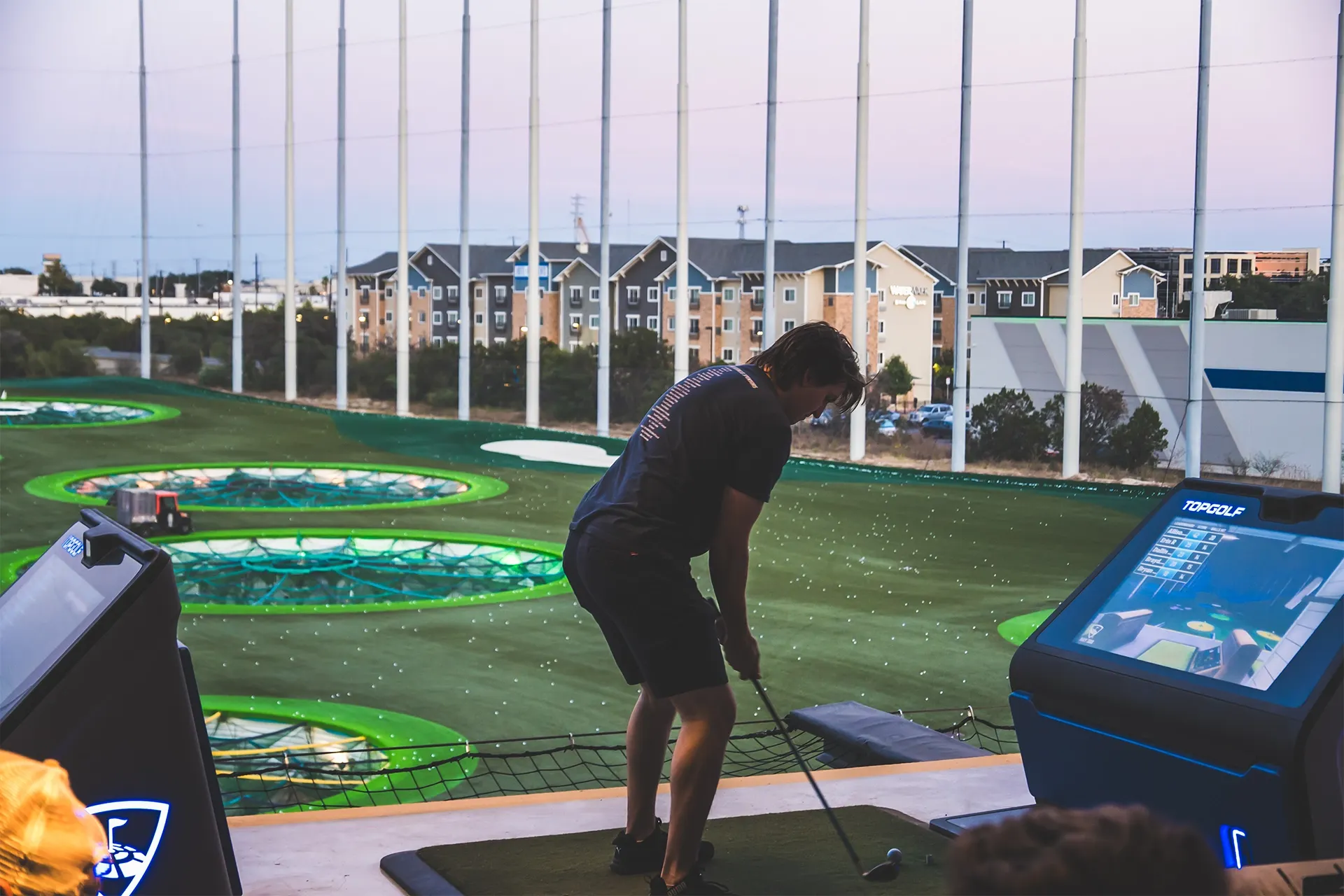
By 2016, Topgolf was a success, millions of customers, dozens of venues. But each new venue was monstrously expensive to build: today the figure runs to $30–50 million per site, funded largely through long-term leases and heavy fixed costs. Growth meant pouring enormous capital into concrete, every single time. The boat was beautiful, but each new boat cost a fortune.
That year, Topgolf bought a ball-tracking technology called Protracer and renamed it Toptracer, the same tracing technology TV viewers see following the ball on golf broadcasts. And someone asked the question that reframes the entire business: why build a $40 million venue to deliver our technology, when we could install that technology in driving ranges that already exist?
This is the pivot. Instead of owning every venue, Topgolf began licensing Toptracer to independent driving ranges - ranges it didn't own, didn't build, and didn't staff. The economics are a different universe from venue-building:
- The range owner pays a monthly licensing fee of roughly $200–225 per day, on contracts that typically run three to five years.
- There are no upfront hardware charges to the operator, and installation takes just two to four days.
- For Topgolf, there's no land, no lease, no kitchen, no construction, just software, cameras, and a recurring bill.
And the value to the range owner was real, not hypothetical. Trial data showed Toptracer-equipped bays nearly doubled the monthly revenue of ordinary bays. At one range in Arlington, Texas, the tech bays brought in 205% more revenue than regular stalls. One early adopter put it to his fellow operators in five words: "if you don't have it, you will be dead."
Look at what happened to the go-to-market. The product - tracking a golf ball and gamifying the result - barely changed between a Topgolf venue and a licensed range. But the distribution model changed completely:
- The venue model: Topgolf controls everything, captures all the revenue, and pays for all the capital. High control, high cost, slow to scale.
- The Toptracer model: Topgolf controls only the technology, captures a thin recurring fee, and pays for almost no capital. Lower control, minimal cost, fast to scale.
This is the central lesson of the whole series, made concrete. Go-to-market is not downstream of the product. It is a separate design decision with its own economics - and the same underlying product can be delivered through a capital-devouring model or a capital-light one. By 2022, Toptracer had installed over 15,000 bays and was adding 8,000 a year, generating predictable, locked-in, high-margin recurring revenue from ranges Topgolf never had to build. It had quietly become the kind of business - software, recurring fees, low capital - that investors prize far more than concrete-and-lease entertainment venues.

The Ending The Success Stories Don't Tell You
Here is where most case studies would stop, with the clever pivot vindicated. But the honest version keeps going, and the ending sharpens the lesson rather than softening it.
In 2020–21, Callaway - the golf-equipment giant - acquired Topgolf in a deal valuing it at roughly $2.6 billion, and renamed itself Topgolf Callaway Brands. For a while it looked brilliant; by 2022 Topgolf was generating nearly 40% of the combined company's revenue. But the two businesses were fundamentally mismatched in exactly the way this article has been describing. Callaway's equipment business was capital-light and cash-generating. Topgolf's venue business was capital-heavy, dependent on building ever more $40-million sites and on consumers having spare money to spend on a night out.
When consumer spending tightened and same-venue sales fell - down about 8% in the first half of 2024 - the mismatch became untenable. In 2024 the company announced it would separate the two businesses, slowing venue construction to just four to six new sites to conserve cash. And note who kept what in the planned split: Callaway kept Toptracer - the asset-light licensing engine - while the capital-heavy venue business was the part being cut loose. The market had decided which model it valued more.
Then the story turned again. The clean public spin-off was abandoned, and in November 2025, Callaway instead sold a 60% stake in the Topgolf venue business to private-equity firm Leonard Green & Partners - at a valuation of about $1.1 billion. A business it had bought for $2.6 billion was sold, in majority, at a fraction of that price. Analysts were blunt about why: the venue model's high capital intensity, long payback periods, and mixed unit economics made it a hard business to love in public markets.
Sit with that contrast, because it is the entire series in one company. The same idea - track a golf ball, make it fun - produced two businesses with opposite fates. The capital-light way of reaching the market (licensing pixels to ranges you don't own) became the prized asset everyone wanted to keep. The capital-heavy way of reaching the market (building venues you own outright) became the burden sold off at a steep discount. Topgolf didn't fail. But the
What A Founder Should Take From This
Strip the golf away and four transferable lessons remain. Each one a thread from Part 1, now with evidence behind it:
- A new category has a long, cold warm-up. Budget for it or die in it. Topgolf needed roughly six years and several near-deaths before word of mouth ignited in Dallas. The product was never the problem; the market's understanding was. If you're building something genuinely new, the runway has to outlast the education.
- The proof of a warming market is a customer the incumbents ignored. The grandmother in the sari, the 37% of Topgolf visitors who don't consider themselves golfers - these are the signals that a new category is real. Watch for the buyer the old industry never imagined, not the approval of the old industry itself (which Topgolf never got).
- Distribution is a design decision, separate from the product. The single most consequential choice Topgolf made wasn't about the technology - it was how to put that technology in front of customers. Own the venue, or license the pixels? Same product, opposite economics. Ask this question about your own business deliberately, not by default.
- Capital-light beats capital-heavy when the market gets to choose. Recurring, low-capital, software-style revenue (Toptracer) was valued far above capital-intensive, build-it-yourself revenue (venues) - by acquirers, by public markets, and finally by a private-equity price tag. If there is a lighter way to reach your market, it is usually worth more than the heavier one, even when the heavier one looks more impressive.
And underneath all four, the Part 1 constant: the Jolliffes survived the cold years on conviction, not data - because their why was strong enough to outlast a decade of people telling them golf-for-everyone was a terrible business. The strategy decided how they reached the market. The belief decided whether they were still standing when the market finally arrived.
In the next article, we leave the driving range for the industry that should know better than any other - technology - where software can scale to millions overnight, and that very speed seduces founders into the most expensive mistake in the startup graveyard: launching too big, too soon.